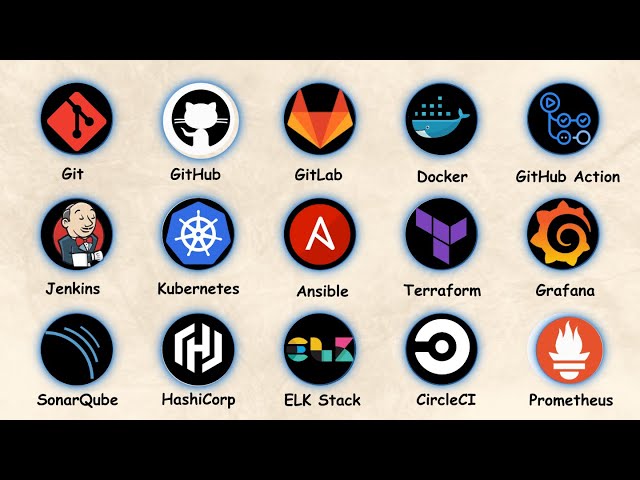
DevOps is a philosophy built on automation, collaboration, and continuous improvement, and it’s powered by a robust ecosystem of tools. This post summarizes the key software every engineer should know, based on the video “Every DevOps Software Explained in 8 Minutes,” covering the full lifecycle from code to production.
1. Source Code Management & Collaboration
The journey of any software begins with the code, managed by Version Control Systems.
- Git [00:00]: The absolute foundation of software development. Think of Git as a time machine for your code, taking snapshots (commits) to create a complete history. Its distributed nature allows developers to work on separate branches and merge them back together safely, making it a critical tool for teamwork.
- GitHub [00:38]: This platform is the “social network for code.” Its killer feature is the Pull Request (PR), which enables team members to review, comment on, and suggest improvements before merging code into the main branch. It also provides essential features like tracking bugs and features via Issues.
- GitLab [01:14]: Offering a complete DevOps platform, GitLab combines code hosting with built-in CI/CD pipelines out of the box. For enterprises needing full control, GitLab can be self-hosted and even includes security scanning, monitoring, and Kubernetes integration.
2. Continuous Integration & Delivery (CI/CD)
Automation is the heart of DevOps, and these tools ensure code is built, tested, and deployed efficiently.
- GitHub Actions [01:50]: Transforms GitHub itself into a powerful CI/CD engine. You define workflows in YAML to automate tasks like running tests, building Docker images, and deploying applications, with thousands of pre-built actions available in the marketplace.
- Jenkins [03:32]: The tried-and-true automation server that has powered CI/CD pipelines for over a decade. Jenkins is renowned for its flexibility, supporting integration with virtually any tool through its over 1,500 plugins. Pipelines are defined as code within a Jenkinsfile.
- CircleCI [07:23]: A cloud-based solution for continuous integration and delivery. By living in the cloud, it eliminates the need to manage infrastructure. It uses reusable configuration packages called Orbs to easily integrate with tools like AWS and Slack.
3. Containerization and Orchestration
These tools solve the problem of consistent deployment by packaging applications and managing them at scale.
- Docker [02:24]: Packages your application and all its dependencies into a standardized, lightweight unit called a container. Containers are highly portable and consistent across environments, helping eliminate the classic “it works on my machine” headache. You define the container using a Dockerfile.
- Kubernetes (K8s) [02:56]: If Docker is about packaging, Kubernetes is about running applications at scale. It acts as a “robot army” managing containers across a cluster of machines. It handles automatic scaling, recovery from failures, and performs rolling updates to ensure zero downtime for complex microservice architectures.
4. Infrastructure as Code (IaC) & Configuration
These platforms automate the provisioning and configuration of servers and cloud resources.
- Ansible [04:07]: Takes complexity out of server configuration with an agentless approach, connecting via SSH. You create simple YAML playbooks that describe the desired state of your systems (e.g., “install Nginx”). It is idempotent, meaning rerunning a playbook won’t cause unintended chaos.
- Terraform [04:46]: Treats infrastructure itself as code, allowing you to define the desired state of servers, networks, and databases across multiple cloud providers (AWS, Azure, GCP) using declarative configurations in .tf files. You can version control your infrastructure just like your application code, making it repeatable and consistent.
- HashiCorp Tools [06:23]: HashiCorp offers a suite of tools that solve critical infrastructure challenges, including Vault (for securely managing secrets like API keys and passwords), Consul (for connecting services across environments), and Packer (for building consistent machine images).
5. Monitoring, Logging & Quality Assurance
Observability and quality checks are crucial for maintaining healthy applications.
- SonarQube [05:55]: Acts as a code review expert that never sleeps. It continuously analyzes your codebase for bugs, vulnerabilities, and code smells. It can be integrated into your CI/CD pipeline to define Quality Gates and block problematic code from reaching production.
- Grafana [05:34]: Transforms complex metrics into beautiful, actionable dashboards. It connects to various data sources to provide real-time insights into system health, application performance, and error rates.
- Prometheus [08:00]: The industry standard for monitoring cloud-native applications. It actively scrapes time-series metrics from your infrastructure and provides a powerful query language, PromQL, pairing with Grafana for visualization and Alert Manager for notifications.
- ELK Stack (Elasticsearch, Logstash, Kibana) [06:51]: This combination transforms the chaos of application and infrastructure logs into searchable and visualized data. Logstash collects the logs, Elasticsearch indexes them for fast searching, and Kibana provides the visualization interface for troubleshooting and analysis.
Leave a Reply