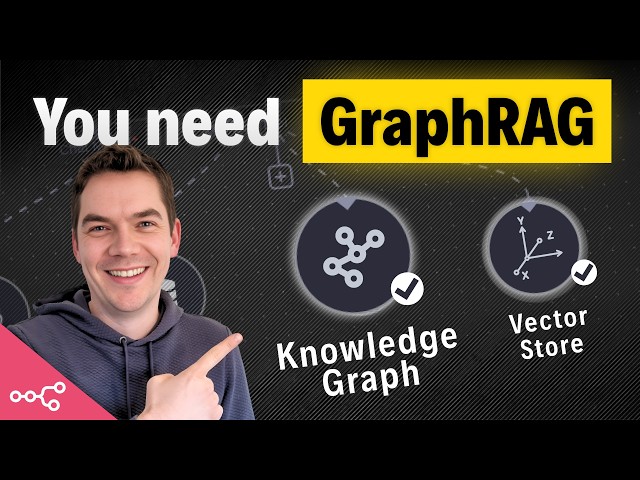
Artificial Intelligence agents are only as good as the context they’re given. Traditional RAG (Retrieval-Augmented Generation) has been a breakthrough for grounding Large Language Models (LLMs) in external knowledge. But RAG has limitations — fragmented context, shallow reasoning, and hallucinations.
That’s where GraphRAG steps in. By combining RAG with knowledge graphs, GraphRAG enables agents to reason more effectively and deliver accurate, context-rich answers.
Why GraphRAG Matters
1. Structured Information
Unlike traditional RAG that works with document chunks, GraphRAG leverages a knowledge graph made up of:
- Nodes → Entities
- Edges → Relationships
- Properties → Details
This structure gives the AI agent an interconnected map of knowledge rather than isolated fragments.
(Timestamp: 01:30)
2. Comprehensive Context
Knowledge graphs provide a holistic context, ensuring the agent has access to the bigger picture. This reduces hallucinations and ensures more accurate, reliable answers.
(Timestamp: 06:02)
3. Multi-Hop Reasoning
A standout feature of GraphRAG is multi-hop reasoning. The agent can traverse multiple relationships across the graph to answer complex queries that require combining insights from different data points.
(Timestamp: 07:12)
Building GraphRAG with n8n
The tutorial also shows how to integrate GraphRAG into n8n workflows for practical applications.
Step 1: Build the Knowledge Graph
- Ingest documents.
- Use an LLM to extract entities, relationships, and properties.
- Store the output in a graph database.
- The demo uses LightRAG, an open-source system.
(Timestamps: 04:50, 12:02)
Step 2: Connect GraphRAG to n8n
- n8n integrates with your graph system (e.g., LightRAG) using the HTTP Request tool.
- This allows your agent to query the knowledge graph directly as part of its workflow.
(Timestamp: 25:59)
Step 3: Hybrid Search
- The n8n agent performs hybrid search by querying both a traditional vector store and the knowledge graph.
- This ensures retrieval of both semantic similarity (vectors) and structured relationships (graph).
(Timestamp: 31:38)
Step 4: Enhanced Response Generation
- The agent combines:
- Context-rich chunks from the vector store.
- Entities and relationships from the knowledge graph.
- The result is a more comprehensive and accurate answer.
(Timestamp: 34:59)
Why This Approach is Powerful
By blending n8n’s agentic workflow automation with GraphRAG’s structured reasoning, you get:
- Richer insights.
- Reduced hallucinations.
- Smarter AI agents that can handle multi-step queries and domain-specific reasoning.
It’s the next evolution of Retrieval-Augmented Generation — and it’s already making AI agents more reliable and capable.
Final Thoughts
Traditional RAG was a great start, but GraphRAG takes AI agents to the next level. With structured graphs, hybrid search, and n8n integration, your AI workflows become smarter, more context-aware, and better equipped to solve complex problems.
Leave a Reply