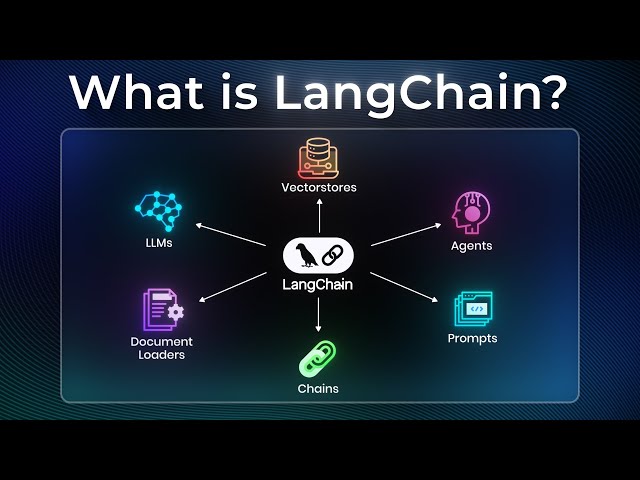
Building a sophisticated AI application like a company chatbot requires more than just calling an LLM’s API. You need memory, knowledge retrieval from internal documents, and the flexibility to switch models. LangChain is an essential abstraction layer that provides a coherent, production-ready framework to manage this complexity with minimal code.
Here is a breakdown of LangChain’s core concepts and components, culminating in a fully functional chatbot.
1. The Core Concept: LLMs vs. Agents
Understanding LangChain starts with knowing the difference between a traditional Large Language Model (LLM) and a LangChain Agent.
- LLM (Large Language Model): An LLM is like a static brain. It answers questions solely based on the data it was trained on. It has no external awareness or memory beyond the current prompt window.
- Agent: An Agent is an LLM with full autonomy, memory, and tools to get a job done. In a customer service scenario, an Agent can perform a complex workflow:
- Understand the user’s intent (using the LLM).
- Retrieve company policy from a knowledge base (using RAG).
- Search an internal database for the customer’s order (using Tools).
- Maintain conversation history (using Memory).
The Agent framework allows developers to provide these capabilities as components, letting the LLM decide how best to use its abilities to complete the task, instead of relying on rigid, pre-programmed, sequential code.
2. Key LangChain Components and Benefits
LangChain provides pre-built, reusable components to address all the painful parts of building an agentic application:
A. Vendor Independence
LangChain’s most powerful feature is its unified interface for connecting to various LLM providers (OpenAI, Anthropic, Google, etc.). This means:
- Easy Setup: Connecting to GPT can be a single line of code (e.g.,
LLM = ChatOpenAI). - Future-Proofing: If your company decides to switch from OpenAI to Anthropic, it is a one-line code change instead of rewriting your entire application, ensuring true vendor independence.
B. Prompt Templates
These are the foundation for managing how input is sent to the LLM.
- Variable Substitution: Used to dynamically insert values into a generic prompt (e.g., filling in “product” and “feature” to generate a unique marketing slogan).
- Chat Templates: Structuring conversations with
System,Human, andAssistantmessages, which is essential for maintaining context and flow.
C. Memory
Memory keeps track of past user inputs and AI responses so the LLM can give answers that are natural, coherent, and contextual across multiple conversational turns. This allows the AI to remember, for example, that the user introduced themselves as “Alice” and loves “Python” for later reference.
D. RAG (Retrieval-Augmented Generation)
RAG connects the chatbot to your actual internal knowledge base. The RAG pipeline involves:
- Loading and Chunking documents (e.g., company policies).
- Creating Embeddings (converting text to semantic vectors).
- Storing the embeddings in a Vector Database (like Chroma or FAISS).
- Retrieval: When a user asks a question, the system retrieves only the most relevant chunks from the database to inject into the LLM’s prompt, allowing it to generate an informed response.
3. Building Pipelines with LCEL
The LangChain Expression Language (LCEL) is the modern way to build and chain these components. Instead of writing long, complex code, LCEL allows you to create simple, composable pipelines using an elegant pipe operator (|).
A complex workflow can be built in one readable line:Prompt | Model | Parser
LCEL offers significant performance and development advantages:
- Streaming-First: Responses start flowing immediately without waiting for the whole answer.
- Asynchronous (Async) Native: Everything runs without blocking, ensuring smoother and faster performance.
- Type Safety: Ensures all inputs and outputs follow the correct structure, preventing unexpected errors.
4. Final Chatbot Demo
By combining these elements—LLM integration, Prompt Templates, Memory, and RAG—you can deploy a fully functional chatbot that combines memory, knowledge retrieval, and multi-model support. LangChain drastically reduces the development time required for production-ready AI applications, allowing teams to accelerate their time to market.
Leave a Reply