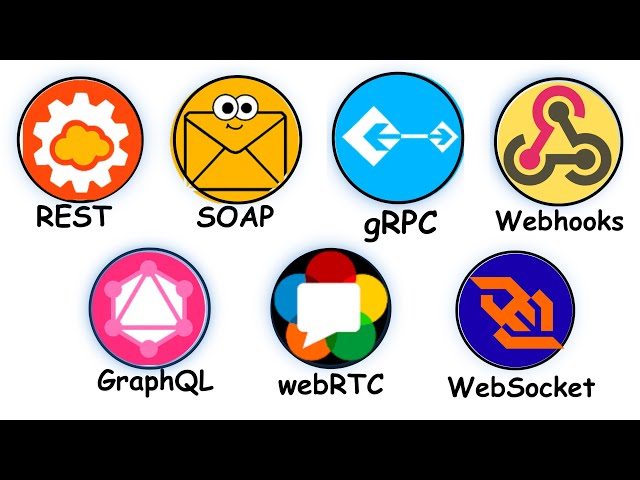
The API (Application Programming Interface) landscape is vast, governing how software components communicate. Understanding the different types is crucial for choosing the right architecture for your application, whether you’re building a massive microservices system or a real-time chat app.
Based on the video “Every Type Of API You Must Know Explained!”, here is a breakdown of the essential API architectures and communication patterns every developer should be familiar with.
1. Request-Response Foundation
These APIs are defined by a client sending a request and waiting for a response. They are the backbone of most web applications.
1.1. REST API (Representational State Transfer)
The most common and popular API type, the REST API is like the waiter at a restaurant: you tell them what you want, and they bring it back [00:08].
- Communication: Stateless; each request is independent [01:03].
- Methods: Uses standard HTTP methods (GET, POST, PUT, DELETE) [00:27].
- Data Format: Typically uses JSON (JavaScript Object Notation).
- Use Case: Ideal for most web services, mobile backends, and public-facing APIs due to its simplicity and platform independence [01:10].
1.2. SOAP API (Simple Object Access Protocol)
If REST is a casual phone call, SOAP is a formal business contract [01:35]. It is one of the oldest and most rigid communication protocols.
- Structure: Every message is wrapped in a strict XML format (Envelope, Header, Body) [01:49].
- Protocol: Highly formal and protocol independent (can run over HTTP, SMTP, TCP) [02:04].
- Use Case: Trusted in industries requiring guaranteed delivery, reliability, and precision, such as banking, finance, and healthcare [02:23].
1.3. gRPC API (Google’s Remote Procedure Call)
Dubbed the “Formula 1 race car of APIs,” gRPC is Google’s modern, high-performance take on the Remote Procedure Call (RPC) idea [03:35].
- Performance: Achieves massive performance gains (often 7 to 10 times faster than REST) [04:28].
- Data Format: Uses Protocol Buffers (Protobuf), a language-neutral, platform-neutral, compact binary format [03:44].
- Features: Takes advantage of HTTP/2 and supports four powerful streaming communication patterns [04:01].
- Use Case: Excellent for internal microservice communication where speed and efficiency are paramount (e.g., Netflix, Uber) [04:36].
2. Data-Centric API
2.1. GraphQL API (Graph Query Language)
Created by Facebook, GraphQL revolutionized data fetching by solving the common problems of overfetching and underfetching [04:46].
- Philosophy: It flips the model, allowing the client to write one query asking for exactly what they want from a single endpoint [05:25].
- Overfetching Solved: Unlike REST, which might send an entire user profile when only the name is needed, GraphQL lets you skip unnecessary data [05:00].
- Features: It is inherently self-documenting and supports real-time subscriptions for live updates [05:32].
- Use Case: Modern applications, especially those serving multiple platforms (web, mobile) where bandwidth and performance are critical [05:58].
3. Real-Time Communication
These APIs are essential for modern applications that need instant, continuous, or server-initiated data updates.
3.1. Web Hook API (Reverse API)
Web hooks flip the traditional communication model—instead of the client constantly checking the server (polling), the server calls the client when an event occurs [06:31].
- Mechanism: When an event happens (e.g., a payment, a code push), the service sends a POST request with the event details straight to the client’s callback URL [06:44].
- Efficiency: Instant, direct, and eliminates wasted requests from polling.
- Use Case: Powering automated workflows in platforms like GitHub (code pushes), Shopify (new orders), and Slack bots [07:09].
3.2. WebSockets API
A WebSockets API is like opening a permanent phone line between your app and the server [07:38].
- Connection: Starts with an HTTP “handshake,” then establishes a single, persistent, two-way communication channel [07:51].
- Communication: Both sides can talk to each other anytime, instantly, allowing the server to push data to the client the moment something happens [08:06].
- Use Case: Perfect for applications requiring continuous, low-latency updates, such as live chat, stock tickers, and multiplayer game events [08:15].
3.3. WebRTC API (Web Realtime Communication)
WebRTC is a full framework that enables direct peer-to-peer (P2P) communication between browsers or mobile apps [08:40].
- Mechanism: The data (video, audio, files) doesn’t need to flow through a central server, making the connection direct and private [08:47].
- Technology: Handles complex networking details like NAT traversal and adaptive bit-rate streaming [09:20].
- Use Case: The backbone of modern video conferencing (Zoom/Google Meet), screen sharing, and online gaming [08:55].
Leave a Reply