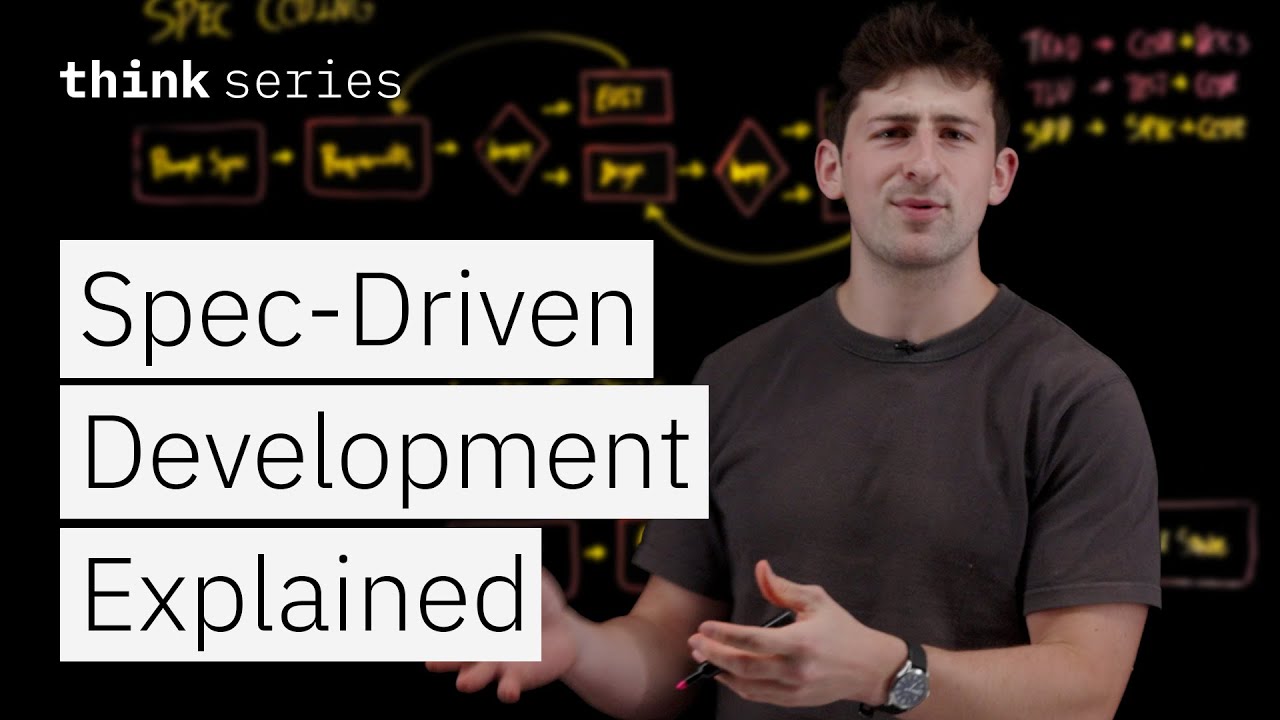
In the rapidly evolving world of AI-assisted development, the way we build applications is undergoing a massive shift. We’ve moved past the era where writing and reviewing code was the primary bottleneck. Today, the real challenge lies in effectively conveying what you want to build to a Large Language Model (LLM).
While many developers have embraced “Vibe Coding,” a more structured approach called Spec-Driven Development (SDD) is emerging as the gold standard for AI engineers.
What is Vibe Coding?
Most developers starting with AI agents (like Cursor, GitHub Copilot, or Replit Agent) engage in Vibe Coding.
How it works:
- The Initial Prompt: You tell the AI, “Build me a login page in Python.” [01:13]
- The Generation: The model generates boilerplate code based on its training data. [01:26]
- The Edit Loop: If it’s not quite right, you edit the prompt and ask for changes. You go back and forth until you reach a “desired vibe.” [01:41]
The Problem: Vibe coding often skips the traditional Software Development Life Cycle (SDLC). Because the AI is essentially “guessing” the best solution, you might get a different result every time you run the same prompt. This lack of predictability can lead to frustration and technical debt. [02:24]
Enter Spec-Driven Development (SDD)
Spec-Driven Development flips the traditional model on its head. Instead of prompting for an implementation, you prompt for the system behavior and constraints. [03:53]
The SDD Workflow:
- The Specification: You start by defining a “contract” or a set of requirements. This includes how the agent should write code, run tests, and handle documentation. [04:09]
- The Design Phase: Before a single line of code is written, the AI generates a design document and a list of “to-dos.” You can approve or edit these instructions at the architectural level. [04:35]
- Implementation & Verification: Once the spec is locked in, the AI agent implements the features. The spec becomes the primary artifact that drives all downstream work, including automated testing. [08:41]
Why It Matters: SDD vs. TDD
We’ve seen transitions before, from Code-First (intuition-based) to Test-Driven Development (TDD), where you write the test before the code. [05:48]
Spec-Driven Development is essentially TDD and Behavior-Driven Development (BDD) on steroids. [06:26] By providing a rigorous specification, you remove the ambiguity for AI agents.
A Practical Example: User Authentication
- Vibe Coding approach: “Make me a login page.” (The AI might choose one of 30 different ways to implement it, leading to endless back-and-forth). [06:49]
- Spec-Driven approach: You define the endpoint (
/login), the request type (POST), the specific variables (user,pass), and the failure codes for missing information. [07:21]
Conclusion
The hardest part of modern programming isn’t the syntax—it’s the communication. By adopting Spec-Driven Development, you provide the “proper instructions” that LLMs crave. This transforms the AI from a tool that “guesses” into a precision instrument that builds exactly what you designed.
Leave a Reply