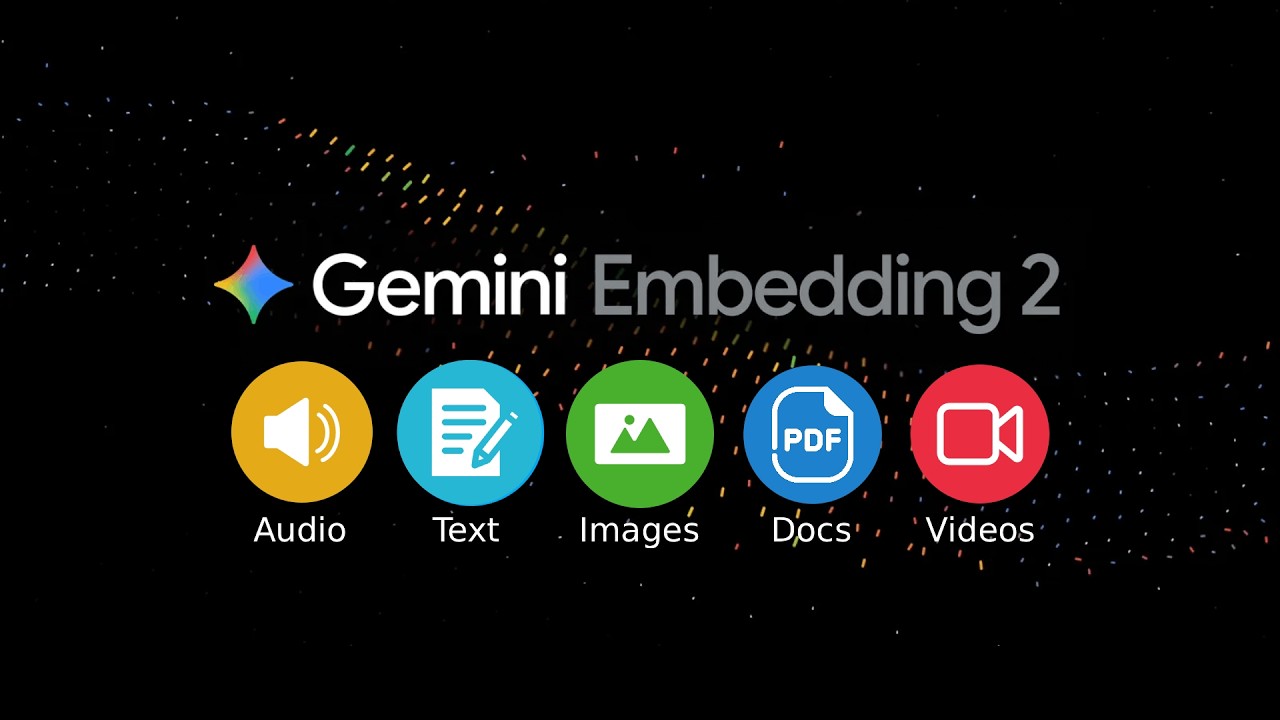
Imagine building a search system that can handle text, images, audio recordings, video clips, and PDFs—all within the same search query. Traditionally, this would require a complex pipeline: multiple vector stores, various specialized embedding models (like CLIP for images or Whisper for audio transcription), and a messy fusion layer to combine the results. [01:32]
With the release of Gemini Embedding 2, Google has collapsed these “five headaches” into a single, natively multimodal API call. [01:48]
What is Multimodal Embedding?
At its simplest, an embedding model converts any piece of content into a list of numbers (a vector) in a high-dimensional space. [02:44] The key property of these vectors is that they encode semantic information.
In a shared vector space, a text description of a cat, an image of a cat, and an audio clip of someone talking about a cat will all cluster in the same “address” or neighborhood. [03:08] Gemini Embedding 2 uses over 3,000 dimensions to ensure these representations are incredibly precise. [03:28]
Key Features & Capabilities
Gemini Embedding 2 is a game-changer because it eliminates the need for preprocessing like transcribing audio or OCR-ing PDFs. [01:12]
- Video Support: Embed videos up to 2 minutes long natively. For longer videos, you can chunk them into 15-30 second segments to allow for hyper-specific timestamp searches (e.g., “Find the part where the woman in the red dress appears”). [08:13]
- Audio Support: Index raw audio files without transcription. [01:20]
- PDF & Document Support: Embed PDFs natively in their original format. [01:20]
- Combined Modalities: You can pass multiple types of content in a single request (e.g., an image + a text description) to get an embedding that represents the combination of both. [05:30]
- Matryoshka Representation Learning: This allows you to shorten the embedding size (e.g., from 3,072 dimensions down to half or a quarter) if you want to trade a bit of semantic fine-tuning for faster lookup speeds and lower storage costs. [10:13]
Performance & Benchmarks
The model isn’t just versatile; it’s powerful. It is already outperforming the original Gemini 001 model in text-to-text similarity and beating other state-of-the-art multimodal models in image-to-text tasks. [09:44]
How to Get Started
The model is currently in preview as gemini-embedding-2-preview. [11:28] Google has ensured “day zero” support for popular frameworks like LangChain, LlamaIndex, and vector databases like Chroma DB and Qdrant. [10:55]
Sample Implementation (Python)
Using the Google Gen AI SDK, you can call the model with just a few lines of code:
Python
response = client.models.embed_content(
model=”gemini-embedding-2-preview”,
contents=image_bytes,
config=types.EmbedContentConfig(task_type=”RETRIEVAL_DOCUMENT”)
)
Use Case Idea: The Ultimate Educational Search
Think of a university course with 50 hours of video. With Gemini Embedding 2, you could index the video, the audio, and the PDF slides. A student could then ask: “Which lessons discussed this specific diagram?”—a task that was nearly impossible to build easily until now. [09:05]
Leave a Reply