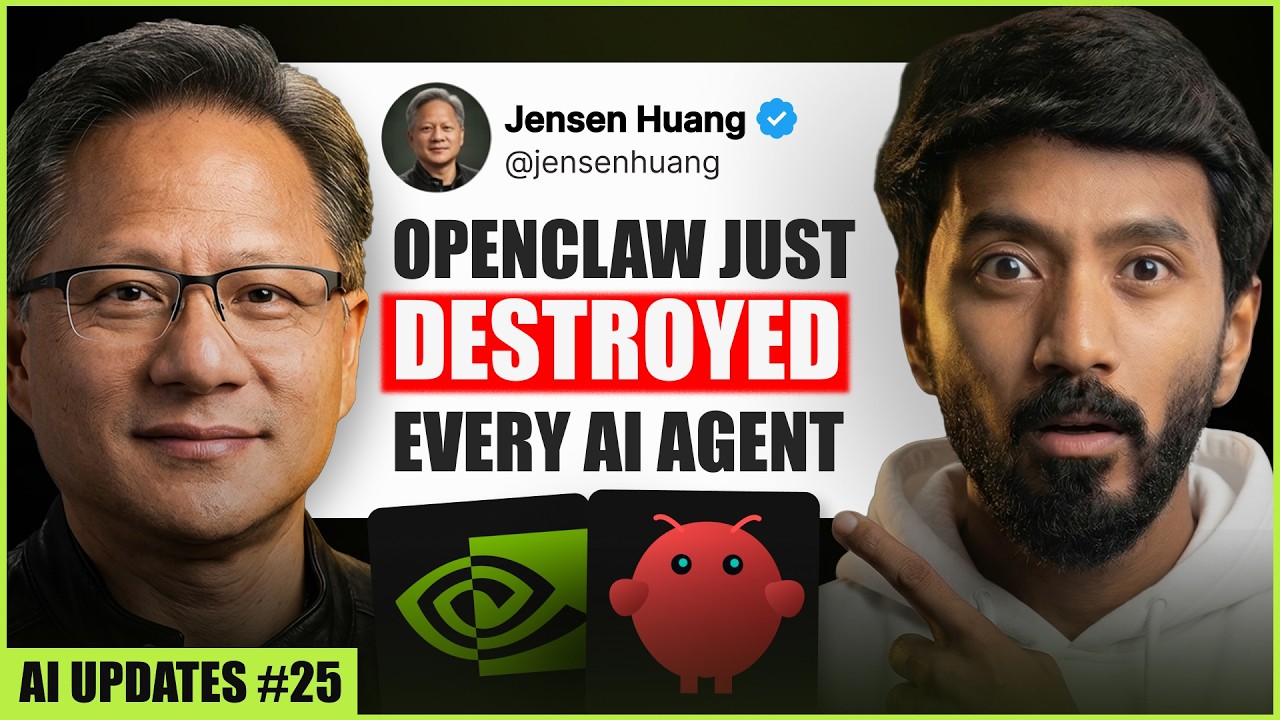
At NVIDIA’s GTC 2026, Jensen Huang made a declaration that has sent shockwaves through the tech world: “Every company in the world today needs an OpenClaw strategy.” Comparing it to the birth of HTML or the rise of Linux, Huang called OpenClaw (the viral open-source AI agent framework) “the new computer” and “the next ChatGPT.” He isn’t wrong—OpenClaw hit 250,000 GitHub stars in just 60 days, making it the fastest-growing open-source project in history [1.1, 1.4].
The Big Reveal: What is OpenClaw?
Created by Peter Steinberger (now at OpenAI), OpenClaw is an autonomous agent framework. Unlike a chatbot that just talks, an OpenClaw “Claw” can:
- Decompose problems: It breaks a goal down into sub-tasks.
- Spawn Sub-Agents: It can create other “claws” to handle specific parts of a job.
- Take Action: It can learn design tools, study reference images, and execute a project (like a kitchen remodel) with zero hand-holding [3.1, 1.5].
12 Critical AI Updates from GTC 2026
- NVIDIA NemoClaw: An enterprise-grade version of OpenClaw. It adds the “guardrails” and privacy controls corporations need to let autonomous agents access sensitive internal data without leaking it [1.5, 3.7].
- DLSS 5 (The “GPT Moment” for Graphics): A controversial update that uses generative AI to fundamentally revamp rendered images, adding realistic skin textures and lighting not present in the original game files [3.5].
- Vera Rubin DSX AI Factory: A new reference design for data centers where hardware and software are “codesigned” to handle the massive token demands of agentic AI [3.7].
- The “Token Salary” Shift: Huang stated that any $500k/year engineer who isn’t consuming at least $250k in AI tokens is “unproductive,” comparing the refusal of AI tools to using a pencil for chip design [3.3].
- Space-Based Data Centers: NVIDIA announced ambitious plans to eventually build data centers in space to meet the insatiable global demand for high-performance computing [2.3, 2.4].
- Groq Hardware Integration: Following a $20 billion deal with the LPU startup Groq, NVIDIA is incorporating their ultra-fast inference technology into its own ecosystem [3.2].
- Nemotron “Omni-Understanding” Models: New AI models designed for vision, voice, and safety that serve as the “brain” for secure enterprise agents [3.7].
- Project “Olaf”: A small, bipedal robot driven by the Jetson computer and the Newton physics engine, marking NVIDIA’s massive push into physical AI [2.1].
- Vera Rubin Chips: Six new chips designed to power “agentic inference”—the phase where AI doesn’t just predict the next word but thinks through a complex task [3.7].
- OpenShell: A new open-source, secure runtime environment for deploying personal AI agents with a built-in safety layer [3.7].
- MoltBook & Moltbolt: The expansion of the “agent-only” social network where OpenClaw agents interact, trade skills, and even (weirdly) created their own digital religions [2.7, 3.2].
- The “Lobster” Community: A nod to the viral trend of “raising lobsters”—the nickname for training and improving personal OpenClaw agents through iterative feedback [1.2, 2.1].
Leave a Reply