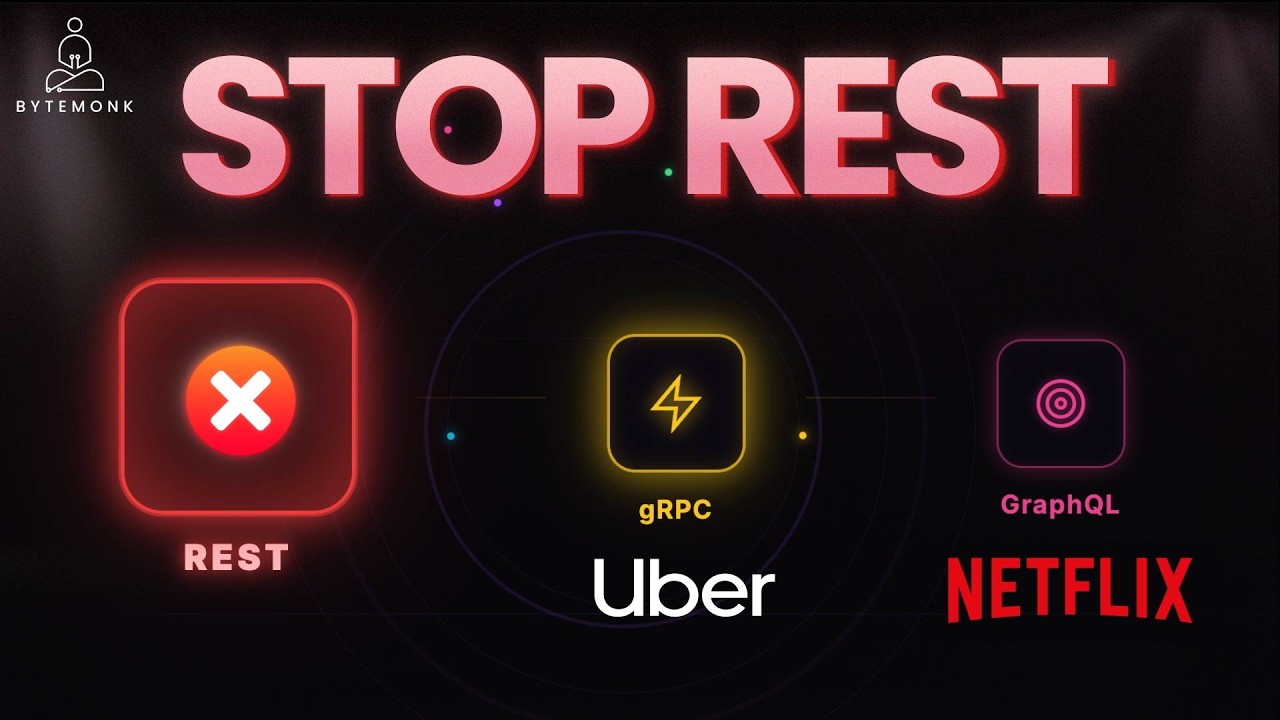
For over a decade, Representational State Transfer (REST) has been the undisputed king of web APIs. It is simple, universally understood, maps beautifully to standard HTTP methods (GET, POST, PUT, DELETE), and handles the requirements of most web and mobile applications with ease.
Yet, if you look under the hood of companies operating at hyper-scale—such as Google, Netflix, Meta, or Uber—you will find that REST is frequently sidelined. Instead, their internal systems are dominated by architectures like gRPC and GraphQL.
Why does Big Tech ditch the industry-standard REST API model? The answer comes down to structural engineering bottlenecks that only appear when you are dealing with billions of requests per second, microservices sprawl, and hyper-optimized mobile performance.
1. The Heavy Payload Problem: JSON Over HTTP/1.1
REST APIs almost universally rely on JSON (JavaScript Object Notation) to transmit data over the network. While JSON is highly human-readable and easy to debug, it is incredibly inefficient at scale.
- Text-Based Bloat: Every single REST payload includes repetitive keys (like
"user_id","first_name", etc.) over and over again in plain text. This wastes massive amounts of bandwidth when scaled across billions of internal microservice calls. - The HTTP/1.1 Protocol Constraint: Standard REST APIs often run over HTTP/1.1, which suffers from Head-of-Line Blocking. A client has to wait for an entire request-response cycle to finish before the same connection can send another request, creating a massive concurrency bottleneck.
How Big Tech Fixes It: gRPC and HTTP/2
To solve this network overhead, Google developed and open-sourced gRPC (Google Remote Procedure Call).
Instead of text-based JSON, gRPC passes data as tightly compressed, binary Protocol Buffers (Protobuf). The keys are stripped out and replaced with tiny numeric identifiers, drastically shrinking the payload size. Furthermore, gRPC runs exclusively natively over HTTP/2, enabling full bidirectional streaming and multiplexing—allowing hundreds of requests to fly across a single TCP connection simultaneously without blocking each other.
2. The Microservices “Chattiness” Nightmare
In a modern microservices architecture, fetching a single page for a user might require a backend application to query dozens of downstream services (e.g., Auth Service, Profile Service, Inventory Service, Recommendations Service).
If these microservices communicate using standard REST endpoints, the system buckles under network latency:
- Each REST call requires a full round-trip TCP/TLS handshake.
- The sequential nature of parsing text-based JSON at every single microservice hop introduces significant computational overhead (CPU serialization/deserialization costs).
By switching internal service-to-service communication to gRPC, Big Tech turns these slow HTTP network requests into lightning-fast, typed function calls that feel as if they are executing directly in-memory, cutting internal latency down to micro-seconds.
3. The Front-End Dilemma: Over-Fetching and Under-Fetching
On the user-facing side of the spectrum, mobile applications struggle with standard REST boundaries due to two fundamental architectural flaws:
- Over-Fetching: A mobile app calls
/api/users/123just to display a user’s avatar. However, the REST endpoint blindly dumps the user’s full profile, registration date, address history, and settings configuration—wasting mobile data and processing power. - Under-Fetching: A dashboard needs to show a user’s name, their recent orders, and their unread notifications. In a strict REST environment, the app must execute three distinct, sequential round-trip requests (
/user,/orders,/notifications) before it can finish rendering the screen.
How Big Tech Fixes It: GraphQL
To resolve this client-side network bottleneck, Meta engineered GraphQL.
GraphQL completely flips the REST paradigm by letting the client explicitly define the exact shape of the data it requires in a single query. The client sends a declarative request to a single GraphQL gateway endpoint, and the gateway handles aggregating the data from multiple backend systems behind the scenes.
The mobile device gets exactly what it needs in a single round trip, saving critical battery life and data on unstable mobile networks.
4. Strict Contract Typings vs. The Wild West of Documentation
REST APIs are structurally loosely typed. While tools like Swagger/OpenAPI help document endpoints, there is no native runtime enforcement ensuring that a backend developer won’t suddenly change a variable from an integer to a string, unintentionally crashing downstream apps.
At Big Tech scale, a minor type mismatch can take down entire processing pipelines.
- gRPC enforces a bulletproof structural contract via
.protoschema files. Code structures for clients and servers are automatically generated directly from this single file. If the types don’t match, the code literally won’t compile. - GraphQL utilizes a strictly typed schema definition language (SDL), ensuring queries are validated on the fly before they ever hit execution paths.
Summary: When Should You Ditch REST?
While Big Tech shifts away from REST for specific engineering constraints, it does not mean REST is dead. For public-facing developer APIs, simple CRUD applications, and standard web architectures, REST remains the best choice due to its simplicity, caching ecosystem, and ease of integration.
However, as your system scales, follow the Big Tech blueprint:
- Use gRPC for high-performance, low-latency microservice-to-microservice communication.
- Use GraphQL for data-hungry, complex client-facing applications where mobile performance and round-trip minimization are paramount.
Leave a Reply