Introduction
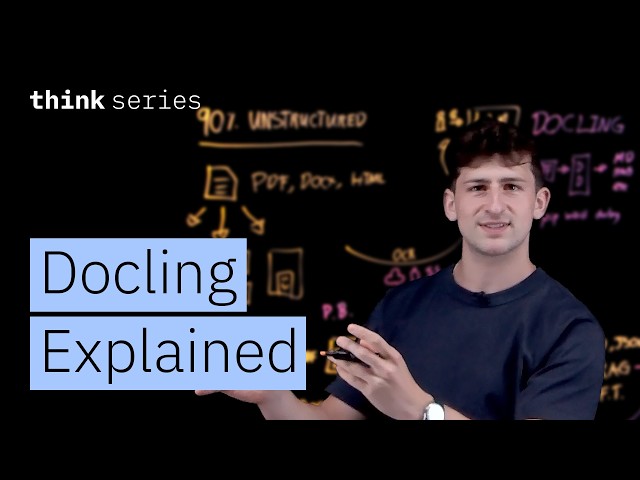
In a world overflowing with unstructured documents—from PDFs and Word files to scanned reports—making sense of them can feel like searching for a needle in a haystack. Enter Docling: an ingenious open-source toolkit developed by IBM Research that transforms messy, unstructured documents into structured, AI-ready formats like Markdown and JSON, preserving context and enabling powerful RAG (Retrieval-Augmented Generation) workflows.
Section 1: What Is Docling and Why It Matters
Docling excels at parsing files—PDFs, DocX, and others—into structured representations, using advanced AI models such as layout-analysis (DocLayNet) and table-recognition (TableFormer). It ensures documents remain contextually intact during conversion arXiv+1YouTube+1.
This capability is especially valuable in:
- AI-driven search systems
- Intelligent document retrieval
- Automated summarization
- Seamless RAG pipelines
By converting unstructured text into clean, organized formats, Docling enables tools like LlamaIndex, LangChain, and spaCy to work more effectively arXiv.
Section 2: How Docling Works
Docling processes documents through a streamlined sequence:
- Parsing input files (e.g. PDF, DOCX)
- Analyzing layout structure using AI models (like DocLayNet)
- Recognizing complex tables (via TableFormer)
- Outputting structured data as JSON or Markdown, preserving titles, tables, paragraphs, and even design context
It supports both API integration and command-line use—flexible for developers and automation alike arXiv.
Section 3: The Community and Impact
Since launching, Docling has made waves:
- Unprecedented popularity—garnering over 10,000 GitHub stars within a month
- Top trending open-source repo globally as of November 2024 arXiv
Implementations with tools like LangChain and LlamaIndex show that Docling isn’t just powerful—it’s already shaping how AI workflows are built.
Section 4: Best Use Cases & Tips
Use Docling when you need to:
- Ingest large volumes of varied files into a unified, queryable format
- Build RAG pipelines to enhance models with external documents
- Automate document ingestion—from research archives to compliance logs
Tips for smooth adoption:
- Start with clear inputs—well-scanned PDFs or digital Word files
- Use the CLI for quick prototyping, and integrate the API for production workflows
- Combine with vector databases or RAG frameworks for full retrieval pipelines
- Monitor performance on large, multi-page files to ensure efficiency
Conclusion
Docling bridges the gap between chaotic real-world documents and structured AI-ready data. Whether you’re building search tools, RAG systems, or intelligent content ingestion pipelines, this open-source toolkit offers accuracy, speed, and community-backed innovation. If you’re eager to tame your document chaos, Docling may just be your next AI ally.
Leave a Reply