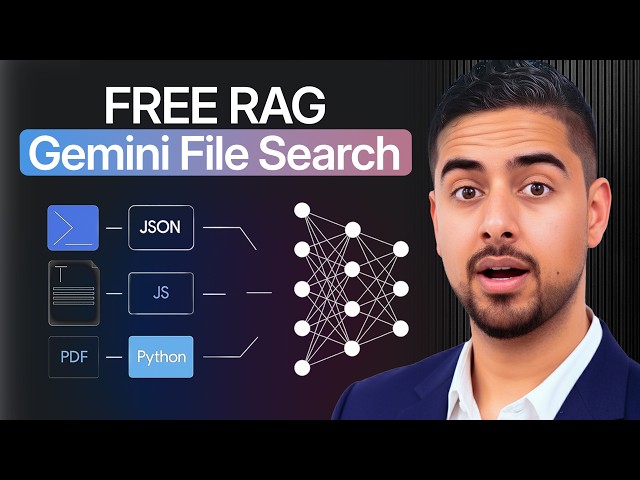
Building truly intelligent AI applications that can answer questions based on your specific data has long been the holy grail for many businesses. This capability, known as Retrieval-Augmented Generation (RAG), prevents Large Language Models (LLMs) from “hallucinating” and ensures their responses are factual and relevant to your proprietary information.
However, implementing RAG has traditionally been a complex, multi-step engineering challenge – until now. Google’s new Gemini File Search API is a game-changer, making the entire RAG pipeline remarkably easy and incredibly cost-effective. It’s essentially a fully managed RAG system built directly into the Gemini API, designed to simplify grounding LLMs with your documents.
The RAG Revolution: From Complex to Click-and-Go
Previously, setting up a robust RAG system involved a series of intricate steps:
- Data Ingestion: Developing pipelines to get your documents into the system.
- Chunking: Strategically breaking down large documents into smaller, meaningful pieces.
- Embedding: Converting these text chunks into numerical vectors using a specialized model.
- Vector Database: Storing these embeddings in a specialized database for efficient similarity search.
- Retrieval Logic: Crafting algorithms to query the vector database and retrieve the most relevant chunks based on a user’s question.
- Prompt Engineering: Injecting the retrieved context into the LLM’s prompt in a way that generates accurate answers.
- Citation Generation: Manually tracking sources to provide citations.
The Gemini File Search API dramatically simplifies this. Think of it as Google taking care of the entire backend complexity, allowing you to focus on your application’s logic.
How it Works (Behind the Scenes):
- Effortless Data Upload: You simply upload your files (PDFs, DOCX, TXT, JSON, code files, up to 100 MB each) directly to a File Search Store.
- Automatic Chunking & Embedding: The API intelligently handles chunking your documents and automatically generates high-quality embeddings using Google’s advanced models.
- Managed Vector Store: These embeddings are stored and indexed within the File Search Store itself – no need for you to manage an external vector database!
- Intelligent Retrieval: When a user queries your application, the File Search API performs a sophisticated vector search, finds the most relevant document chunks, and dynamically injects them into the Gemini model’s prompt.
- Built-in Citations: Crucially, the responses automatically include citations that pinpoint the exact document and section from which the information was retrieved, boosting trust and verifiability.
The Cost Factor: RAG Just Got Cheap!
Beyond simplicity, the pricing model for the File Search API is exceptionally developer-friendly and designed to be highly cost-effective, turning a potentially expensive operational overhead into a predictable expense.
- FREE Storage: You pay absolutely nothing for storing your indexed documents (up to project limits, typically 1 GB for the free tier).
- FREE Query-Time Embedding: The cost of embedding the user’s query for retrieval is completely free.
- One-Time Indexing Cost: Your primary cost is a mere $0.15 per 1 million tokens for the initial indexing (embedding creation) of your documents. You pay this only once when you upload and process your files.
- Standard Gemini API Rates: You only pay for the tokens sent to the Gemini model (the retrieved chunks plus the user’s query) and the tokens generated in the response, just like any other Gemini API call.
This structure is a game-changer. It means you can build and scale robust RAG systems with vast knowledge bases without worrying about continuous, unpredictable vector database costs or complex infrastructure management.
Key Benefits for Developers:
- Speed & Simplicity: Go from raw documents to a RAG-powered application in minutes, not days or weeks.
- Accuracy & Trust: Ground your LLM responses in your own data, drastically reducing hallucinations and providing verifiable citations.
- Cost-Effectiveness: Eliminate expensive vector database hosting and operational costs.
- Scalability: Built on Google’s infrastructure, ensuring low-latency performance even with large document sets.
- Versatility: Supports a wide range of document types, including PDFs, DOCX, TXT, JSON, and common code files.
The Gemini File Search API is a significant leap forward in making advanced AI accessible. It empowers developers to create more accurate, reliable, and intelligent applications faster and more affordably than ever before. If you’re looking to leverage the power of LLMs with your private data, this tool is an absolute must-explore.
Leave a Reply