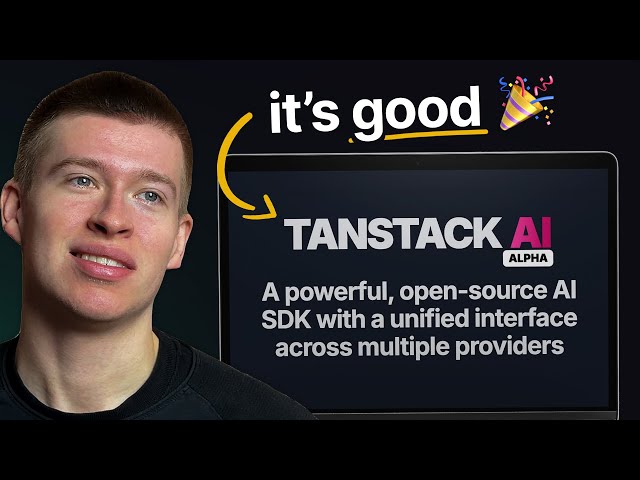
For years, Vercel’s AI SDK has been the dominant, modern way to build robust AI agents, but a new, formidable competitor has emerged: Tanstack AI. Given that the Tanstack team is behind ubiquitous libraries like React Query, this new offering is the first real challenger with a massive ecosystem backing it.
While Tanstack AI is currently in an alpha pre-release, its features and design philosophy position it as a genuine threat to the established order.
https://www.youtube.com/watch?v=b47n-DTPT3k
The Unified Interface: Seamless LLM Switching
The core value proposition of any modern AI SDK is abstraction, and Tanstack AI delivers a unified interface that works across all major LLM providers (OpenAI, Anthropic, O Llama, etc.) [01:45].
- Provider Agnostic: The vast majority of your agent’s code remains identical, regardless of the underlying AI model you choose. You simply pass a different “adapter” string to the Tanstack AI client [01:17].
- Broad Compatibility: It’s not just for React developers. Tanstack AI is built to support vanilla TypeScript, React, Solid, as well as backend languages like PHP and Python [01:09, 01:24].
Superior Developer Experience (DX) and Agent Building
Even in its alpha stage, the developer experience is highly impressive and built for enterprise-level safety:
- Type Safety is Paramount: The SDK provides automatic type inference, meaning you get model autocompletion. Crucially, the configuration options (like prompt cache key or retention) are provider-specific and fully type-safe [02:01, 02:33]. If a setting doesn’t apply to a model like Anthropic, it simply won’t be available, eliminating runtime errors.
- Tool and Function Calling: Essential for building complex AI agents, Tanstack AI includes an automatic execution loop for tool and function calling [03:07]. Developers can maintain control using agent loop strategies, such as setting a
max_iterationslimit, ensuring the AI agent behaves predictably and returns a result to the front end within defined boundaries [03:29].
The Pure Open-Source Advantage: No Vendor Lock-in
Perhaps the most significant difference between the two SDKs is their business model. Vercel uses its AI SDK to drive adoption of its paid ecosystem (like the AI Gateway, AI Elements, and AI Accelerator) [05:32].
Tanstack, however, makes a direct claim: it is not a service [04:17].
- No Middleman: Tanstack AI is a pure open-source ecosystem with no service fees or a middleman between you and the AI provider.
- Decentralized Control: This open-source philosophy ensures no vendor lock-in, which resonates strongly with developers tired of committing their applications to a single platform’s commercial stack [04:34].
A Clean and Established API
With its history in developing widely adopted libraries like React Query, the Tanstack team delivers a clean and beautiful API. The code required to set up a complete, streaming AI chat application is remarkably concise for both the server-side (using a stream in the API endpoint) and the client-side (using a hook similar to Vercel’s useChat) [08:00, 08:26].
Tanstack AI is just beginning its journey, but backed by one of the most established open-source development teams in the web ecosystem, it represents a very real alternative for any developer who values type safety, modularity, and a pure, vendor-neutral approach to building the next generation of AI applications.
Leave a Reply