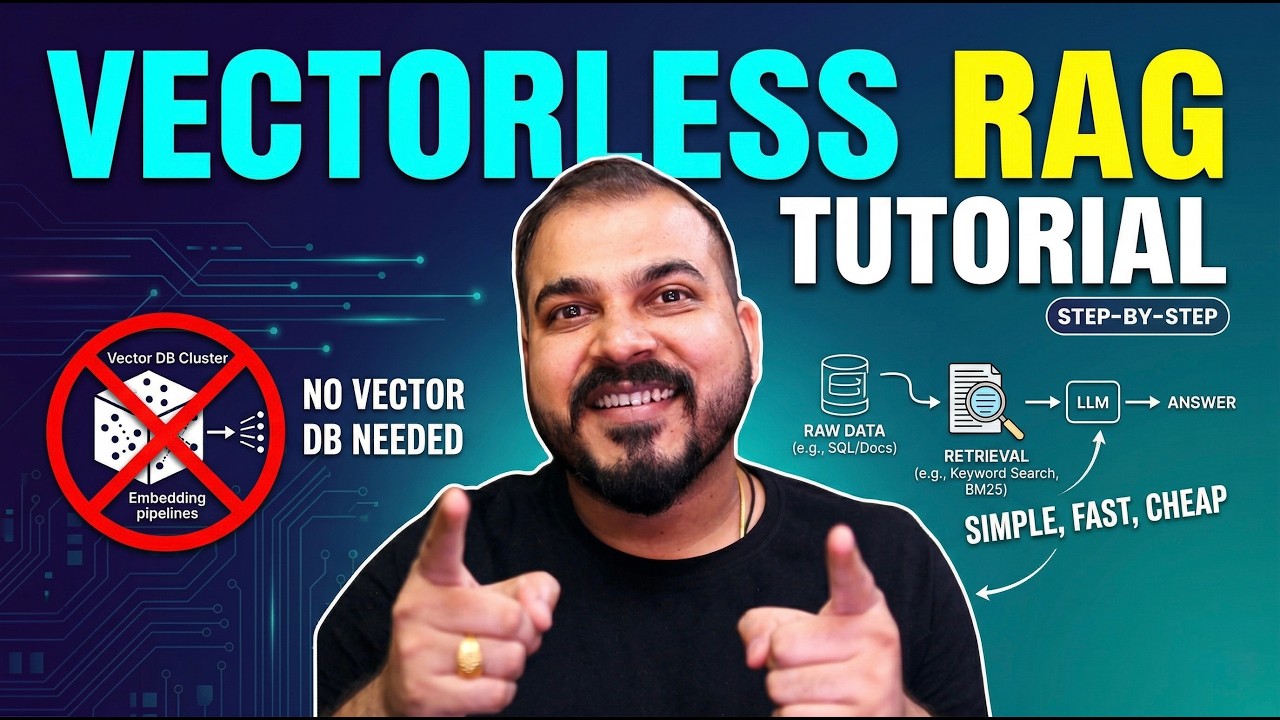
In the rapidly evolving world of Large Language Models (LLMs), Retrieval-Augmented Generation (RAG) has become a standard for providing context to AI. Traditionally, this meant building complex pipelines involving document chunking, embedding generation, and management of vector databases. However, a new trend is emerging: Vectorless RAG.
In this tutorial, inspired by Krish Naik’s recent deep dive, we explore how to implement Vectorless RAG using PageIndex—a method that eliminates the need for vector databases and rigid chunking.
What is Vectorless RAG?
Traditional RAG relies on converting text into high-dimensional vectors (embeddings) and performing similarity searches. While effective, it has drawbacks:
- Irregular Chunking: Standard splitters might break a paragraph in the middle of a thought.
- Context Loss: Similarity search doesn’t always understand the hierarchical structure of a document (like a book’s chapters).
- Infrastructure Overhead: Managing a vector database (Pinecone, Milvus, etc.) adds complexity.
Vectorless RAG shifts the focus from “similarity” to “reasoning over structure.” It builds a hierarchical LLM Tree Index of your document. When you ask a question, the LLM acts like a human expert—it looks at the Table of Contents (TOC), understands the sections, and navigates directly to the relevant content. [05:26]
How PageIndex Works: The LLM Tree Builder
The core of this approach is the creation of a JSON Tree Index.
- TOC Detection: The system scans the document for an existing Table of Contents. If one isn’t found, the LLM reads the pages to infer headings and logical boundaries. [12:19]
- Section-Aware Summarization: Instead of arbitrary token counts, the document is split based on logical sections (e.g., “Introduction,” “Module 1”). The LLM then generates a summary for each node in the tree. [14:05]
- The Reasoning Loop: When a user query arrives, the LLM scans the tree’s summaries and titles to identify which nodes contain the answer. It then retrieves the full text from those specific sections to generate the final response. [15:12]
Practical Implementation
Krish demonstrates the power of the pageindex library with a practical Python example using an AI course syllabus.
1. Setup
You’ll need a PageIndex API key and an OpenAI API key.
Python
from pageindex import PageIndexClient
client = PageIndexClient(api_key=”YOUR_PAGEINDEX_KEY”)
2. Indexing the PDF
Uploading a document triggers an asynchronous process that builds the hierarchical tree. For a 50-page PDF, this typically takes 30-90 seconds. [22:08]
3. Inspecting the Tree
You can traverse the resulting JSON to see how the LLM has organized the document into nodes, each with its own “page index summary.” [23:42]
4. The “Reasoning” Retrieval
Instead of a similarity search, you perform an LLM Tree Search. You pass the query and the tree structure to the LLM, asking it to identify the most relevant node IDs. Once the IDs are identified, the system pulls the exact context needed for the final answer. [24:51]
Key Advantages
- No Vector DB Setup: Significantly reduces infrastructure requirements. [10:38]
- Precise Citations: Because it understands sections and page numbers, the LLM can provide highly accurate citations in its answers. [27:19]
- Human-Like Navigation: It respects the logical boundaries of the text, ensuring that context isn’t lost during retrieval. [11:06]
Conclusion
Vectorless RAG represents a shift toward more intelligent, structure-aware AI systems. By leveraging PageIndex and LLM reasoning, developers can build RAG applications that are easier to manage and often more accurate for professional, structured documents.
Leave a Reply