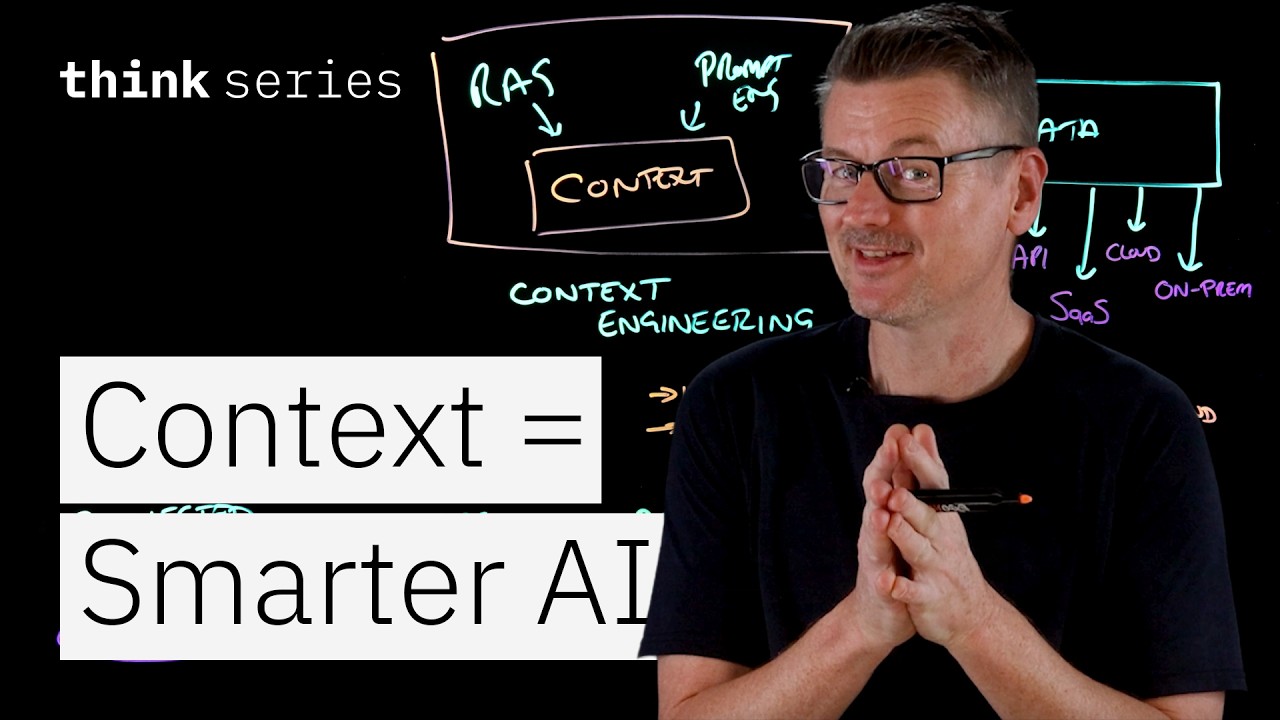
In the rush to deploy generative AI applications, organizations quickly discover a frustrating truth: large language models (LLMs) are only as good as the context you give them. When an AI app gives a generic, incorrect, or entirely hallucinated response, the underlying problem is rarely the model itself—it is a failure of context.
As Martin Keen from IBM explains, context is the single biggest bottleneck in getting AI to do what you want. While simple semantic search architectures helped us get started, building truly reliable, enterprise-grade AI systems requires shifting toward Context Engineering, Retrieval-Augmented Generation (RAG), and advanced GraphRAG models.
Here is a deep dive into how these precision retrieval strategies work, why they drastically improve relevance, and how they provide the data governance modern enterprises demand.
1. The Context Bottleneck in Enterprise AI
When you prompt a vanilla LLM, you are querying its static training data. To make it useful for specific business tasks, you have to feed it relevant enterprise data. However, blindly dumping data into a prompt creates three massive system strains:
- Token Waste: Feeding thousands of pages of unstructured data into a model’s context window rapidly drives up your cloud inference costs.
- Information Degradation: LLMs suffer from “lost in the middle” syndrome—they tend to ignore or misinterpret key data hidden in the middle of massive text walls.
- Lack of Control: Passing raw data directly into a prompt makes it incredibly difficult to enforce strict corporate access controls or data lineage tracing.
Context Engineering is the structural discipline of dynamically curating, optimizing, and feeding the exact slice of information a model needs at the precise moment it needs it.
2. Standard RAG: The Evolution of Semantic Search
To solve the context bottleneck, the industry standard became Retrieval-Augmented Generation (RAG).
In a baseline RAG pipeline, documents (like PDFs, markdown files, and web pages) are broken down into smaller text chunks. These chunks are passed through an embedding model to turn them into mathematical vectors and stored in a specialized vector database.
When a user asks a question, the system vectorizes the query, searches the vector database for text chunks with the highest mathematical similarity, and appends those chunks to the user’s prompt as background context. The LLM then synthesizes an answer based only on that verified data.
The Limits of Standard RAG
While baseline RAG is great for locating isolated facts (e.g., “What is our policy on parental leave?”), it falls flat on complex, holistic queries. Because standard RAG relies purely on localized word similarity, it struggles to answer global questions that require cross-referencing multiple themes or conceptual entities across different documents (e.g., “Summarize the top three product vulnerabilities identified across all our Q3 engineering audits”).
3. Enter GraphRAG: Bringing Knowledge Graphs to Vector Spaces
To bridge the conceptual gaps left by standard semantic search, engineering teams are upgrading to GraphRAG.
Instead of treating your enterprise data as an unorganized pile of isolated text chunks, GraphRAG builds a structured Knowledge Graph out of your data before indexing it.
How GraphRAG Works under the Hood
- Entity Extraction: An LLM scans your document corpus to identify distinct entities (e.g., specific software modules, engineering teams, client accounts, or compliance rules).
- Relationship Mapping: The system establishes explicit relationships between these entities (e.g., Module A “depends on” Library B, which is managed by Team C).
- Community Summarization: Graph algorithms automatically group highly interconnected entities into clusters or “communities,” pre-generating high-level summaries for each cluster.
When a user queries a GraphRAG system, the architecture retrieves both the highly relevant local vector chunks and the overarching relational maps. This gives the AI a rich, structural overview of how concepts link together, enabling it to synthesize highly accurate, systemic answers across disparate data points that standard vector searches would completely miss.
4. The Enterprise Benefits: Relevance, Governance, and Performance
Implementing structural context engineering and GraphRAG provides a massive leap forward for production AI systems:
- Precision Relevance: By leveraging both vector similarity and explicit knowledge graphs, the AI consistently delivers highly specific, context-aware answers that eliminate generic fluff.
- Hard-Coded Governance: Knowledge graphs provide an audit trail. You can trace exactly which documents, entities, and relational nodes were accessed to generate a specific response, making it easier to enforce role-based access limits.
- Resource Performance: Instead of maximizing context windows with bloated, unformatted text files, precision retrieval pipelines keep payloads tight and highly relevant—slashing your token bills and maximizing model throughput.
Summary: Elevate Your Data Infrastructure
Moving towards autonomous AI agents doesn’t mean finding a more powerful foundational model; it means building smarter data pathways around the models you already use. By combining standard RAG for fast keyword lookups with the relational depth of GraphRAG, you can transition your AI systems away from unreliable, hallucination-prone chatting and toward highly secure, reliable enterprise performance.
Leave a Reply