Organizing Modern AI Systems into a Structured Mental Model
The rapid evolution of artificial intelligence has created a landscape with many overlapping terms and technologies such as prompt engineering, large language models (LLMs), retrieval-augmented generation (RAG), autonomous agents, guardrails, and frameworks. For practitioners, product teams, and leaders, understanding how these pieces interconnect can be challenging.
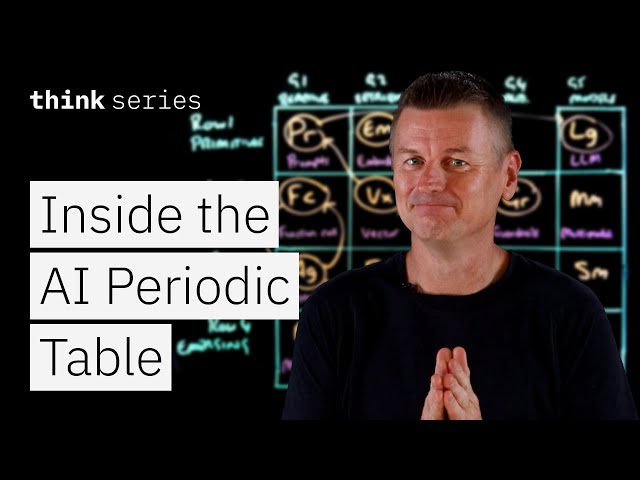
The YouTube video “AI Periodic Table Explained: Mapping LLMs, RAG & AI Agent Frameworks” provides a visual, structured model — inspired by the chemical periodic table — to break down and categorize AI system components. This AI Periodic Table helps audiences decode complex generative AI architectures and understand how fundamental building blocks combine to create real-world AI solutions.
What the AI Periodic Table Framework Is
The AI Periodic Table organizes AI concepts into hierarchical groups similar to how elements are arranged in chemistry:
- Primitives (Foundational Elements):
- Prompts (instructions that drive model behavior)
- Embeddings (semantic vectors that represent meaning)
- Large Language Models (LLMs — the core reasoning engines)
- Compositions (Value-Generating Patterns):
- Function Calling (tool executions)
- Vector Databases (semantic memory storage)
- RAG (Retrieval-Augmented Generation)
- Guardrails (safety, validation, constraints)
- Multimodal Models (processing text, vision, etc.)
- Deployment (Production-Ready Components):
- Agents (autonomous systems that plan/act)
- Frameworks (orchestration libraries like LangChain)
- Fine-Tuning (domain adaptation)
- Red Teaming (adversarial testing)
- Small Models (fast and cost-efficient)
- Emerging & Future Capabilities:
- Multi-Agent Systems (collaborative AI components)
- Synthetic Data
- Interpretability tooling
- Thinking Models (reasoning-centric architectures)
This structured presentation helps developers, architects, and decision-makers see where key aspects of AI sit in the stack and how they interact.
How the AI Periodic Table Helps You Understand AI
1. Provides a Shared Terminology
Like chemistry’s periodic table, this framework gives teams a common language to discuss AI components such as prompts, guards (Gr), RAG (RG), and agents (Ag). This reduces ambiguity when designing or reviewing AI systems.
2. Maps Components to Practical Use Cases
• A RAG-based chatbot system might combine prompts, embeddings, vector databases, RAG logic, an LLM, and guardrails.
• An agentic system combines elements such as agents, function calling, and orchestration frameworks to allow AI to autonomously perform tasks. This makes it easier to design architectures that fit real needs rather than just listing buzzwords.
3. Supports Governance and Risk Assessment
By decomposing AI into elemental pieces, enterprises can systematically audit models and workflows for safety, privacy, compliance, and bias — addressing challenges in regulating autonomous or production-scale AI.
Why This Framework Matters Today
Modern AI is no longer just a single chatbot or a standalone model. It involves:
- Grounded generation via RAG to reduce hallucinations and incorporate real data.
Autonomous behavior via agents that plan, act, and learn.
Production-grade orchestration that combines multiple elements for safe, scalable deployments.
The AI Periodic Table framework helps align technical discussions with strategic decision-making and governance practices, making it easier to architect robust solutions and evaluate risk.
Conclusion
The IBM AI Periodic Table Explained video breaks down the complexity of modern AI systems into manageable, categorized components. By treating foundational building blocks like prompts, embeddings, LLMs, and agents as parts of a structured taxonomy, the model simplifies how practitioners think about system design, deployment, safety, and future innovation. Whether you are designing AI products, leading adoption efforts, or governing enterprise AI, this framework offers a clear mental model that bridges strategy, architecture, and execution.
Leave a Reply