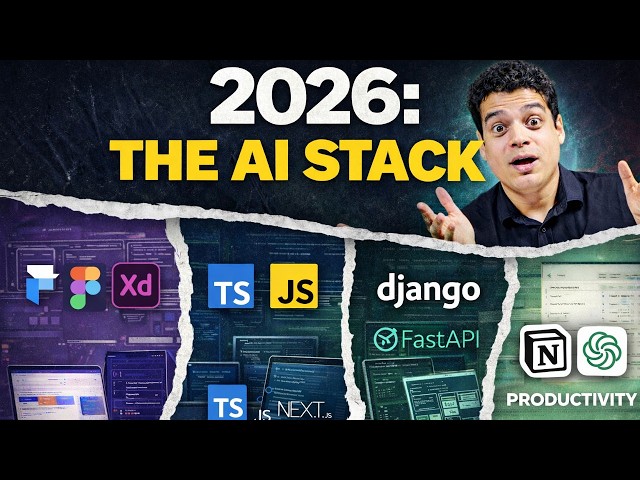
As we step into 2026, the landscape of software development has shifted dramatically. Coding is no longer just about syntax; it’s about productivity, planning, and architectural thinking. With AI generating massive amounts of code through tools like Claude and Gemini, the role of a developer has evolved into that of a “system architect.”
In a recent deep-dive, Tanay Pratap shared the essential toolkit every developer needs to stay relevant this year. Whether you are a fresher or a seasoned pro, these are the tools that are defining the modern workflow.
1. UI Development: The New Gold Standard
The way we build front-ends has been revolutionized by AI-friendly libraries.
- Shadcn UI + Tailwind CSS: This is now the de facto standard. AI models like Gemini and V0 naturally write code in Tailwind and Shadcn, making it easy to copy-paste primitives directly into your codebase where you (or your AI agent) can easily edit them [02:12].
- TanStack Query & TanStack Router: While React Router is still popular, TanStack’s ecosystem is winning for high-performance apps. It handles complex features like pre-fetching and optimistic updates right out of the box [03:01].
- Framer Motion: For those “cool” scroll animations and gesture supports (drag-and-drop), Framer Motion is the go-to. It makes web apps feel premium and polished [04:12].
2. Testing: The Safety Net for AI Code
- Playwright: In an era where AI writes most of the code, we often don’t review every line. Playwright is essential for End-to-End (E2E) testing. It ensures that new AI-generated features don’t break existing ones, allowing you to ship at maximum velocity [05:06].
3. Back-end & AI Engineering
Back-end development is no longer a messy collection of task managers and queues.
- Temporal: This tool is a game-changer for distributed systems. It simplifies complex back-end workflows, which is crucial now that we are running heavy AI inferences and agentic workflows [07:11].
- FastAPI: As Python dominates the AI space, FastAPI has become the standard due to its speed, built-in documentation, and dependency injection [08:39].
- Zod & Pydantic: Since JavaScript and Python (the two kings of AI SDKs) are not strictly typed, Zod (for JS) and Pydantic (for Python) are vital to catch errors at runtime and ensure AI doesn’t produce “garbage” data [09:26].
4. The “One” Database to Rule Them All
- PostgreSQL: If you only learn one tool this year, make it Postgres. It has evolved to handle SQL, Vector Search (for AI), and JSON all in one place. It has effectively become the “Shaktiman” of databases [10:46].
5. Productivity & Brainstorming
- tldraw / Excalidraw: Visual thinking is more important than typing speed. Drawing a UI or system architecture and feeding that screenshot to an LLM like ChatGPT allows for incredible brainstorming [12:30].
- Linear: Known as the “Jira Killer,” Linear is designed specifically for developer productivity. It’s keyboard-centric, fast, and eliminates the clutter of traditional project management [13:44].
- Vibe Coding Tools (Replit, Lovable, v0): While they might still break things occasionally, these tools are perfect for “vibe coding”—rapidly prototyping ideas to see how they look and feel before committing to a full build [14:35].
Final Thoughts
For freshers, Tanay recommends focusing on Zod/Pydantic, FastAPI, and Postgres. For working professionals, mastering Temporal and Postgres is non-negotiable for handling modern, large-scale AI systems
Leave a Reply