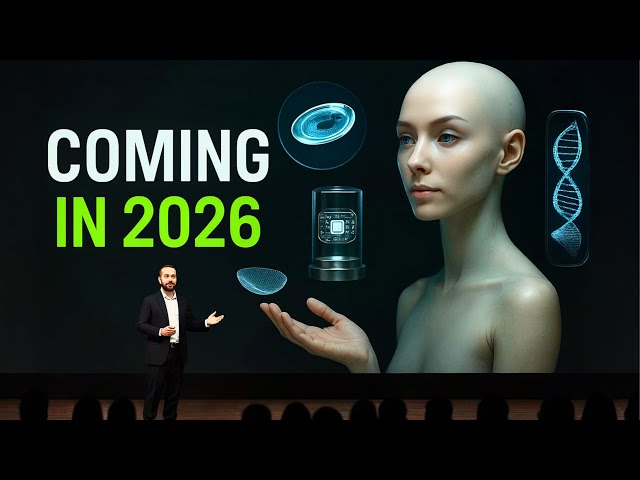
By 2026, artificial intelligence and emerging tech are on track to automate up to 70% of everyday tasks, fundamentally transforming how we live, work, and interact with machines. The following 17 trends are not just futuristic predictions—they’re already unfolding before our eyes.
17. Low-Code / No-Code Development
Over 75% of new apps will be built using platforms like Glide, Bubble, Microsoft Power Apps—enabling people without engineering backgrounds to build tools. OpenAI’s custom GPTs and platforms like Google’s AppSheet are making workflow automation accessible without traditional coding.
16. AI-Crafted Experiences in Extended Reality
AI-driven XR spaces will create environments that adapt based on your behavior. Nvidia’s characters converse naturally. Meta’s avatars react and improvise. Virtual spaces will dynamically reshape, like shops that rearrange themselves based on user movement.
15. Smart Infrastructure & IoT 2.0
With over 30 billion IoT devices expected, we’ll see technologies like traffic systems adjusting in real time, warehouse automation, and multi-use smart city “poles” that monitor everything from pollution to device charging.
14. Privacy-First AI & Local Processing
New legislation like GDPR and CCPA, plus advancements in hardware, are pushing AI computation on-device. Examples include Apple’s local AI processing, Meta’s offline modeling, and Intel’s chips with AI accelerators—keeping data private and reducing latency.
13. Workflow Automation at Scale
Software from UiPath, Zapier, ServiceNow isn’t just automating single tasks—entire business operations are being automated. Hiring, invoicing, inventory, customer support—all with minimal human hand-off.
12. AI-Enhanced Robotics in Retail & Logistics
Robots are walking, mapping, and performing tasks autonomously: from shelf scanning at Walmart to food delivery bots (Starship, Kiwi) and warehouse robots (Agility Robotics’ Digit). These changes address worker shortages and boost efficiency.
11. AI-Native Operating Systems
Operating systems are becoming proactive AI partners. Microsoft’s Copilot for Windows 11 is one example, summarizing your files, rewriting texts, and generating content without switching apps. Expect similar integrations from Apple and others.
10. Advanced Health Wearables
Wearables now do more than track steps—they monitor recovery, stress, sleep cycles. Coming developments include continuous blood sugar monitoring without finger pricks, non-invasive blood pressure devices, early illness detection, and AI-driven personalized health nudges.
9. Quantum Computing Nears Utility
Quantum hardware is finally doing more than theoretical problems. Companies like IBM, Google, IONQ, and Rigetti are working on error correction and real-world applications such as molecule simulation, supply chain optimization, and hardware scaling.
8. AR Glasses Replace Screens
We’re moving toward lightweight smart glasses with augmented overlays—live captions, navigation cues, translations appearing in your field of view. With AI reading context, these might replace phones for quick information.
7. AI Personalizes Healthcare
Healthcare is becoming predictive: Retinal disease detection, sepsis risk prediction, personalized chemo regimens—all powered by AI analyzing large data sets. These tools offer early warnings and tailor treatments based on individual biology.
6. Edge AI Chips Everywhere
Smarter devices: phones, laptops, tablets—all with built-in AI capability. Examples already include Apple’s A-series chips, Qualcomm’s Snapdragon X Elite, and Intel’s Meteor Lake architecture. Expect fast, efficient AI tasks on device without cloud dependencies.
5. AI-Powered Home Assistants
Robotic assistants are gaining mobility and functionality. Amazon’s Astro navigates home, delivers commands; China’s humanoid showroom assistants are already serving customers; rumors of Apple’s own robotic companion are circulating.
4. Humanoid Robots Go Commercial
Not just prototypes: humanoid robots are entering real workplaces. BMW is working with Figure AI; Tesla’s Optimus is performing basic assembly tasks. Robots are walking, lifting, sorting—with hardware becoming affordable enough for scale.
3. AI Agents That Work For You
From AutoGPT to Devon (by Cognition Labs), AI agents are handling complete tasks: planning travel, building websites, debugging code. Businesses are leveraging them for onboarding, customer service, data management. You give direction—they execute.
2. Generative AI Becomes Default
The majority of content will be AI-assisted or AI-generated by 2026. Multimodal systems (text, image, video, audio) will become mainstream. Tools like Adobe Firefly, Runway ML, Eleven Labs are making creative work faster, more accessible, more experimental.
1. The Rise of Brain-Computer Interfaces (BCIs)
The wild but increasingly real: devices that connect brain signals to computers. Neuralink’s 2024 implantation enabled a user to move a cursor with thought; Synchron, Precision Neuroscience, and others are developing devices to restore communication or movement in paralyzed patients. The implications are enormous.
Leave a Reply